google
yahoo
bing

Research

In the Emotion and Self Lab, we study the process, structure, expression, and regulation of emotions and self. Much of our research is focused on self-conscious emotions (pride, shame, embarrassment, and guilt) emotions that are intricately entwined with complex self-evaluative processes. But we also study more basic level emotions, such as anger, fear, sadness, and happiness. We use a wide range of methods to study emotional processes, including behavioral observation and coding, social-cognitive techniques, cross-cultural comparisons, cross-sectional and longitudinal designs, factor analysis, cluster analysis, and content-coding. In an effort to improve the study of self-conscious emotions, we have developed several measurement tools that are available to other researchers. These tools are briefly described below, and can be downloaded or copied and pasted from this website.

Research in the lab is currently funded by the Social Science and Humanities Research Council of Canada (SSHRC) and the Michael Smith Foundation for Health Research (MSFHR) of British Columbia.

To read media coverage of some of our recent research, click here.

Emotion Assessment Tools

Theoretical Model of Self-Conscious Emotions

**Note: While this model is not exactly a research tool, we hope it can be utilized or extended by others.

The drawing below shows a theoretical process model of self-conscious emotions, reprinted from Tracy, J. L., & Robins, R.W. (2007). Self-conscious emotions: Where self and emotion meet. In C. Sedikides & S. Spence (Eds.), The self in social psychology. Frontiers of social psychology series (pp. 187-209). New York: Psychology Press. [PDF]

A slightly different version of the model was first published in Tracy, J. L., & Robins, R. W. (2004). Putting the self into self-conscious emotions: A theoretical model. Psychological Inquiry, 15, 103-125. This paper describes the model in greater detail. [PDF]

diagram01.png Note: The dotted arrow connecting Locus Attribution and Embarrassment indicates that a public self-representation must be activated in order for embarrassment to occur.

7-Item Authentic and Hubristic Pride Scales

Development and validation of these scales are reported in: Tracy, J. L., & Robins, R. W. (2007). The psychological structure of pride: A tale of two facets. Journal of Personality and Social Psychology, 92, 506-525. [PDF]

These scales have been translated for use in German samples [PDF] and Spanish samples [PDF].  For information regarding the German translation please contact Gavin Sullivan Gavin.Sullivan@med.monash.edu.au.  For information regarding the Spanish translation please contact Julieta Cassone jcassone@fmed.uba.ar

Instructions for state pride measure:
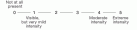
Below are a number of words and phrases that describe different feelings and emotions. Read each item and then indicate the extent to which you feel this way using the scale shown below:

Instructions for trait pride measure:
Below are a number of words and phrases that describe different feelings and emotions. Read each item and then indicate the extent to which you generally feel this way (i.e., how you feel on the average) using the scale shown below:

emo_scale.gif

Authentic Pride Items

  1. accomplished
  2. like I am achieving
  3. confident
  4. fulfilled
  5. productive
  6. like I have self-worth
  7. successful

Hubristic Pride Items

  1. arrogant
  2. conceited
  3. egotistical
  4. pompous
  5. smug
  6. snobbish
  7. stuck-up

Pride Nonverbal Coding Scheme

This coding scheme is based on findings reported in Tracy, J. L., & Robins, R. W. (in press). The prototypical pride expression: Development of a nonverbal coding scheme. Emotion [PDF]; and Tracy, J. L., & Robins, R. W. (2004). Show your pride: Evidence for a discrete emotion expression. Psychological Science, 15, 194-197. [PDF]

The scheme was validated in Tracy, J. L., & Matsumoto, D. (in press). The Spontaneous Display of Pride and Shame: Evidence for Biologically Innate Nonverbal Displays. Proceedings of the National Academy of Science. [PDF]

*Note: this coding scheme also includes behaviors relevant to shame, based on Izard, C.E. (1971). The face of emotion. East Norwalk, CT: Appleton-Century-Croft; Keltner, D. (1995). Signs of appeasement: Evidence for the distinct displays of embarrassment, amusement, and shame. Journal of Personality and Social Psychology, 68, 441-454; and Lewis, M., Alessandri, S.M., & Sullivan, M.W. (1992). Differences in shame and pride as a function of children’s gender and task difficulty. Child Development, 63, 630-638.

Instructions for coders:
For each of the following, please rate the intensity of the particular behavior or movement using the scale below. If the behavior or movement is not present, score it as 0.

emo_scale2.gif

Head Codes

  1. Head tilted back/up ___
  2. Head tilted forward/down ___
  3. Smile ___
  4. Moving hands to cover face or part of face___
  5. Hiding face by moving face or head (in hands, onto ground, into upper arm, turning away, etc.)___

Arm Codes

  1. One or both arms out from body ___
  2. One or both arms raised ___
  3. One or both hands in fists ___
  4. Hands on hips ___
  5. Arms crossed on chest___
  6. One or both arms limp at sides___

Body Codes

  1. Chest expanded ___
  2. Torso pushed out/leaning back ___
  3. Chest narrowed inward ___
  4. Shoulders slumped forward___

Coding scheme:

Pride components = Head 1, Head 3, Arms 1, Arms 2, Arms 3, Arms 4, Arms 5, Body 1, and Body 2. Not all components must be present to code pride. Necessary components for greater than chance recognition are: Head 3 + [Head 1 or (Arms 1 + Arms 2 + Arms 3) or (Arms 4) or (Arms 5)]; or Head 3 + Arms 6 + Head 1 + (Body 1 or Body 2). Necessary components for reliable recognition at more stringent levels (greater than 70%) are: Head 3 + Arms 1 + Arms 2 + Arms 3 + Head 1; or Head 3 + Arms 1 + Arms 2 + Arms 3 + (Body 1 or Body 2); or Head 3 + Arms 4 + Head 1; or Head 3 + Head 1 + (Body 1 or Body 2).

Shame components: Head 2, Head 4, Head 5, Arms 6, Body 3, and Body 4. Not all components must be present to code shame. Accurate recognition can occur from Head 2 + (Head 4 or Head 5).

UC Davis Set of Emotion Expressions (UCDSEE)

Reference: Tracy, J. L., Robins, R. W., & Schriber, R. A. (2009). Development of a FACS-verified set of basic and self-conscious emotion expressions. Emotion, 9, 554-559. (PDF)

This new set of emotion expressions includes jpegs of anger, embarrassment, fear, disgust, happiness, pride, sadness, shame, and surprise expressions. All basic emotion expressions (including contempt) were FACS-verified by Erika Rosenberg, a leading expert in FACS, and all self-conscious emotion expressions were verified by Dr. Rosenberg to include only those facial muscle movements described as relevant to each expression by Tracy & Robins (Psych Science, 2004) for pride, and by Heerey et al. (Emotion, 2003) for embarrassment and shame. The set includes 4 targets: 2 females (1 Caucasian American, 1 African) and 2 males (1 Caucasian American, 1 African). Researchers interested in using the set can download or copy jpegs below, free of charge; please just cite the set with the appropriate reference.

Click on the photos to enlarge.
Anger

anger1 anger2 anger3 anger4

Disgust

disgust1 disgust2 disgust3 disgust4

Embarrassment

embarass1 embarrass2 embarrass3 embarrass4 amemb-hand.JPG wfembar2-hand.jpg wmembar2-hand.jpg

Fear

fear1 fear2 fear3 fear4

Happiness

hap1 hap2 hap3 hap4

Neutral

deka-neutral.jpg amneutral.jpg wfneutral.jpg elneutral1.jpg

Pride

pride1 pride2 pride3 pride4 afpr1.jpg ampr1-nahile-v2.JPG wfpr1.jpg wmpr1.jpg

Sadness

sad1 sad2 sad3 sad4

Shame

shame1 shame2 shame3 shame4

Surprise

sup1 sup2 sup3 sup4


Latest News

Azim Shariff will be leaving the lab this August to start his new job as an Assistant Professor at University of Oregon. Congrats, Azim!

Jess Tracy’s paper providing evidence for automatic emotion recognition among adolescents with autism is now in press at JADD.

Joey Cheng's MA thesis accepted for publication at Evolution and Human Behavior! Download the paper here.

Edited Volume

"The Self-Conscious Emotions". Click here to buy your copy.


UBC Emotion & Self Lab is powered by WordPress 2.9.1 and K2 edited by Creative B'stro | Admin Login